
Mūkapacca Jātaka
The Tale of the Mute Paccekabuddha
In the realm of Mithila, where prosperity bloomed and wisdom was cherished, a virtuous king named Suppāraka ruled with a heart as vast as the sky. His reign was a beacon of justice, and the land flourished under his benevolent gaze. Yet, even in this idyllic kingdom, a whisper of discontent could be heard, a subtle unease that troubled the king's peace. It was the quiet suffering of the common folk, who, despite the king's goodness, were still bound by the chains of ignorance and greed, their minds often clouded by the dust of worldly desires. The king, a Bodhisatta in his past life, yearned to awaken their inner light, to guide them towards the path of enlightenment. He knew that true happiness lay not in material wealth, but in the cultivation of the mind and the practice of virtue.
One day, as the king sat in his royal court, listening to the petitions of his subjects, a story reached his ears that stirred his soul. It spoke of a Paccekabuddha, a solitary enlightened being, who lived in a magnificent hermitage nestled deep within the Himalayas. This Paccekabuddha, it was said, had achieved profound wisdom and compassion, yet he was afflicted by a curse of muteness, unable to utter a single word. Despite his silence, his presence radiated an aura of peace and serenity that drew countless devotees to his hermitage, seeking solace and guidance. The king, intrigued and inspired, felt a strong desire to meet this extraordinary individual, to learn from his silent wisdom.
He summoned his most trusted advisors and declared his intention. "I shall embark on a pilgrimage to the Himalayas," he announced, "to seek the counsel of the Mute Paccekabuddha. I wish to understand how one can impart wisdom without the use of speech, and how such a blessed being can inspire so many through his silent presence." His advisors, though concerned about the arduous journey, respected their king's resolve and pledged their support. Preparations were made, and with a retinue of loyal followers, King Suppāraka set forth on his quest.
The journey was fraught with challenges. They traversed treacherous mountain passes, navigated dense forests, and braved harsh weather. Yet, the king's determination never wavered. He meditated on the virtues of patience and perseverance, drawing strength from the image of the Mute Paccekabuddha. After many weeks of travel, they finally arrived at the foot of a majestic mountain, said to be the dwelling place of the enlightened one. A narrow, winding path led upwards, disappearing into the clouds.
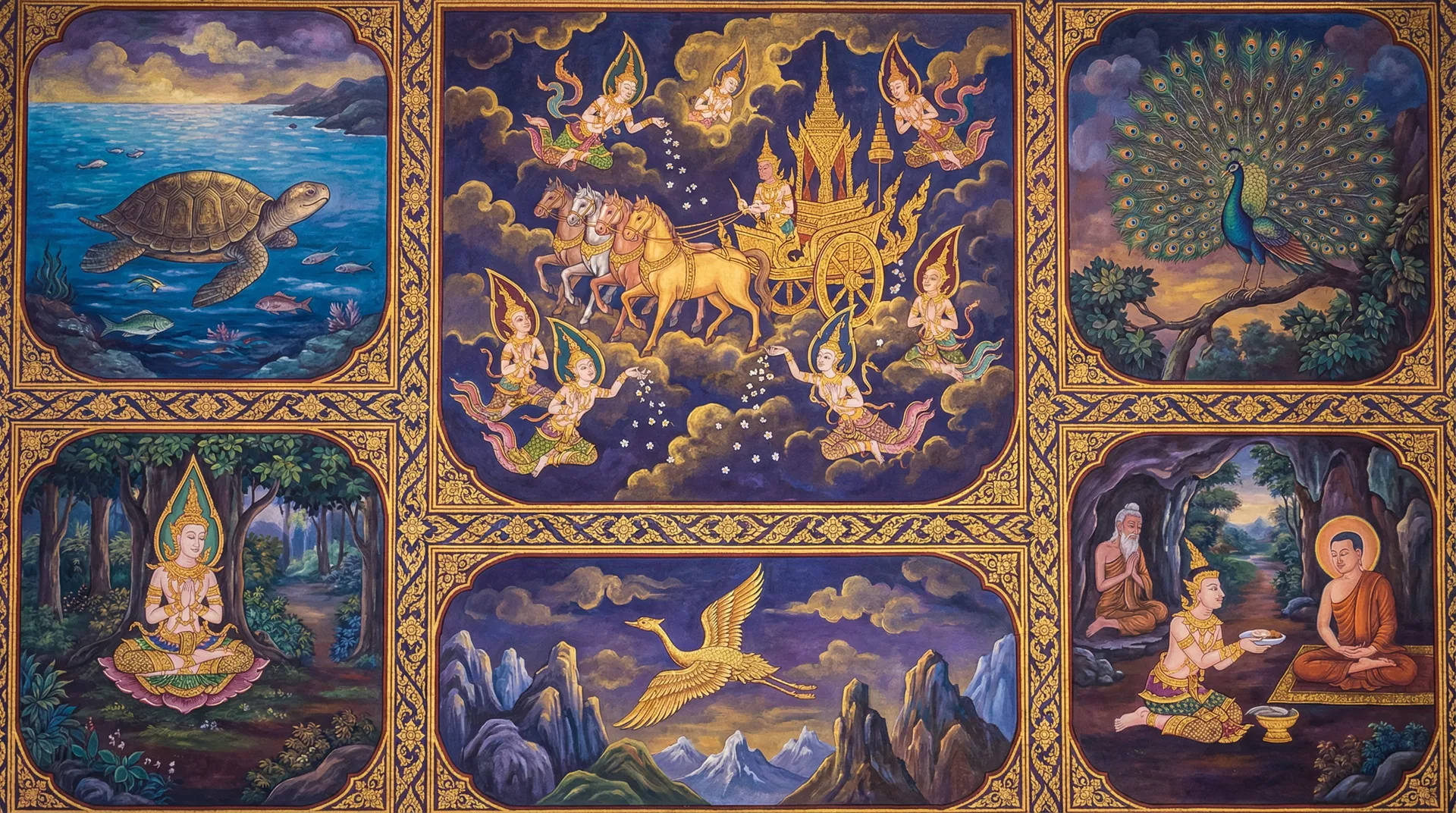
As they ascended, the air grew colder, and the silence more profound. Suddenly, they heard a faint, melodious sound, like the gentle chiming of bells. Following the sound, they discovered a breathtaking hermitage, carved from a single, colossal crystal. In the center of a serene courtyard, bathed in ethereal light, sat the Paccekabuddha. He was a figure of immense grace, his eyes radiating a profound stillness, his countenance serene and unperturbed. He was indeed mute, his lips sealed, yet his presence was a sermon in itself.
King Suppāraka, filled with reverence, approached the Paccekabuddha and bowed deeply. He sat before him, his heart open, ready to receive the silent teachings. The Paccekabuddha, without uttering a sound, extended his hand, palm upwards. On his palm, a lotus flower bloomed, its petals unfurling to reveal a single, radiant pearl. He then gently closed his hand, and the pearl vanished. He repeated this gesture, and each time, a different precious jewel appeared on his palm – a sapphire, an emerald, a ruby, a diamond – only to disappear as he closed his hand.
The king watched, mesmerized. He understood. The Paccekabuddha was not merely showing him treasures; he was demonstrating the impermanence of all material possessions. Wealth, like these fleeting jewels, could appear and disappear in an instant. True wealth, the king realized, lay not in hoarding but in detachment, in the ability to let go. He further understood that wisdom, like the radiant pearl, could be found within, a treasure that no one could take away.
The Paccekabuddha then gestured towards a small stream flowing nearby. As the king looked, he saw his own reflection in the water. The Paccekabuddha pointed to the reflection, then to his own serene face, and finally to the king's own thoughtful expression. The king grasped the meaning: the true self, the Buddha-nature, resided within each being. The Paccekabuddha was not separate from him; he was a mirror reflecting the potential for enlightenment that lay dormant in every heart.
The king spent several days at the hermitage, absorbing the silent lessons. He learned to observe the world with a quiet mind, to find joy in simplicity, and to cultivate compassion for all beings. The Paccekabuddha's muteness was not a deficiency but a powerful tool, forcing those who sought him to listen not with their ears, but with their hearts. He taught that true understanding comes from within, from introspection and mindful awareness.
When the time came to depart, King Suppāraka felt a profound sense of gratitude. He bowed once more to the Mute Paccekabuddha, his heart overflowing with wisdom. As he descended the mountain, he carried with him not jewels, but a treasure far more precious: the understanding of true contentment and the path to inner peace. He returned to Mithila, not as a king seeking external validation, but as a Bodhisatta ready to share the silent wisdom he had gained. He implemented policies that encouraged mindfulness, discouraged greed, and fostered a spirit of detachment and generosity among his people. The kingdom of Mithila, under his renewed guidance, became a true sanctuary of peace, a testament to the power of silent wisdom and the enduring strength of the Bodhisatta's compassion.
— In-Article Ad —
💡Moral of the Story
True wisdom and wealth are found not in external possessions, but in detachment and the cultivation of inner peace. Silence can be a powerful teacher, urging us to listen with our hearts.
Perfection: Wisdom (Prajna)
— Ad Space (728x90) —
More Jataka Tales You May Enjoy
 66Ekanipāta
The Great Crane Jataka
Long ago, in an age when the Buddha had not yet appeared, in a time immeasurably distant, the Bodhis...
💡 True wealth is measured not by the abundance of possessions, but by the happiness and prosperity of one's people. Greed leads to suffering, while generosity and compassion bring true prosperity.
 410Sattakanipāta
Cattari Puttajataka
Cattari Puttajataka In the prosperous kingdom of Kasi, ruled a wise and benevolent king named Brahma...
💡 True and lasting happiness is not found in the endless pursuit of material possessions, intellectual achievements, or even in the heavy burden of constant good deeds, but in the cultivation of inner contentment, appreciating the present moment, and finding joy in life's simple blessings.
9EkanipātaThe Generous Merchant
The Generous MerchantIn the bustling port city of Bharuch, where the air was thick with the scent of...
💡 True wealth lies in selfless giving, which ultimately brings its own abundant rewards.
31EkanipātaThe Bodhisatta as a King of Elephants
The Bodhisatta as a King of ElephantsIn the heart of a vast and verdant forest, where ancient trees ...
💡 Wise leadership, determination, and the ability to inspire trust can guide a community through perilous journeys to safety.
21EkanipātaThe Bodhisatta as a Serpent
The Bodhisatta as a SerpentIn the cool, dark depths of a sacred cave, nestled within the shadow of t...
💡 The purest compassion, even at the cost of one's existence, can bring forth miraculous blessings.
19EkanipātaThe Bodhisatta as a Lion
The Bodhisatta as a LionIn the heart of a vast, sun-baked desert, where sand dunes stretched as far ...
💡 True leadership lies in selfless sacrifice for the well-being of subjects, bringing immeasurable blessings.
— Multiplex Ad —